
stelauconseil/oid4vp-backend
OpenID for Verifiable Presentations (OID4VP) is the protocol that lets a relying party — the verifier — request ISO mdoc credentials or W3C VCs from a holder’s wallet. As EUDI Wallet deployments roll out across Europe, the pressure is on to build compliant verifier backends that handle the full cross-device flow: QR code generation, signed Authorization Request serving, encrypted response decryption, and mdoc parsing.
This is a walkthrough of oid4vp-backend, our implementation targeting the France Identité wallet and OID4VP Draft 18.
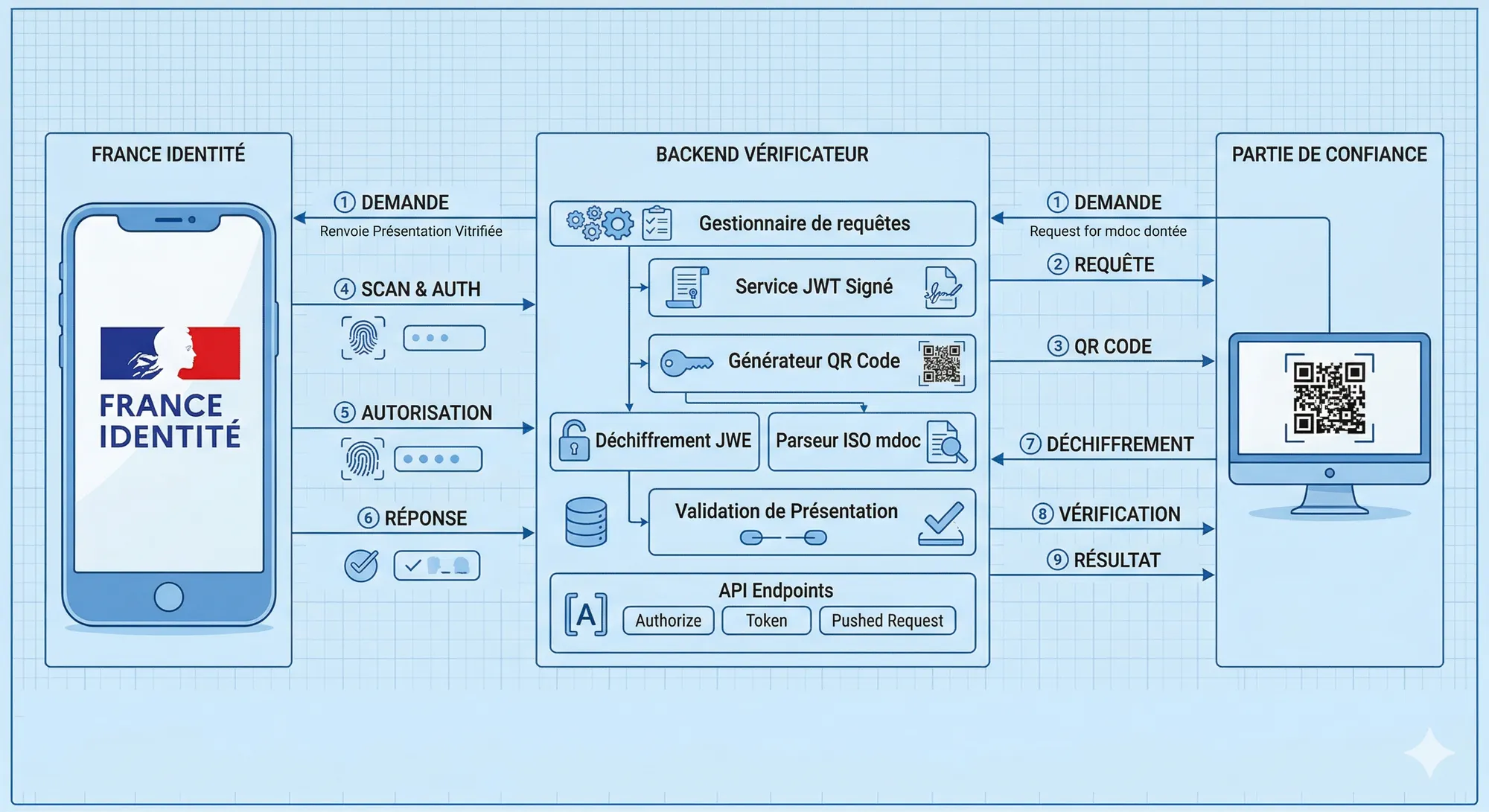
The Cross-Device Flow
The cross-device QR flow is the primary interaction model for web-based verification. The user is on a desktop browser; their wallet is on mobile. The sequence looks like this:
Browser            Backend              Wallet (mobile)
  |                   |                      |
  |-- GET /qrcode --> |                      |
  |                   |-- store session --   |
  |<-- QR deep-link --|                      |
  |                   |                      |
  |-- GET /poll/:id ->|                      |
  |   (long-polling)  |                      |
  |                   |                      |
  |                   |<- GET /request-obj --|  (QR scan)
  |                   |--- signed JWT ------>|
  |                   |                      |
  |                   |<--- POST /response --|  (VP Token JWE)
  |                   |-- store response --  |
  |                   |--- redirect_uri ---->|
  |                   |                      |
  |<-- claims data ---|                      |
The key insight: the QR code does not embed the full Authorization Request. It only contains a request_uri pointing back to the backend. The wallet fetches the signed JWT separately — this gives the verifier a chance to bind the session state to that specific scan.
Building the Authorization Request
The backend generates a UUID per QR session. That UUID serves as both the state parameter and the key for the in-memory session store.
// src/oid4vp/request.js
export async function buildAuthorizationRequest(uuid, type = "age_over_18") {
  const nonce = uuidv4();
  const presentationDefinition = getPresentationDefinition(type);

  const payload = {
    aud: env.CLIENT_ID,
    response_type: "vp_token",
    response_mode: "direct_post.jwt",
    client_id: env.CLIENT_ID,
    client_id_scheme: env.CLIENT_ID_SCHEME,
    response_uri: env.RESPONSE_URI,
    redirect_uri: "",
    require_signed_request_object: true,
    client_metadata: buildClientMetadata(),
    nonce,
    state: uuid,
    presentation_definition: presentationDefinition,
    iss: env.CLIENT_ID,
    iat: Math.floor(Date.now() / 1000),
    exp: Math.floor(Date.now() / 1000) + 300,
  };

  const jwt = await new SignJWT(payload)
    .setProtectedHeader({
      alg: "ES256",
      typ: "oauth-authz-req+jwt",
      x5c: signing.x5cChain, // DER-encoded certificate chain
    })
    .sign(signing.privateKey);

  requestObjects.set(uuid, jwt);
  store.set(uuid, { status: "generated", request: presentationDefinition });

  const deepLink = `${env.AUTH_SCHEME}://?client_id=${encodeURIComponent(env.CLIENT_ID)}&request_uri=${encodeURIComponent(`${env.BASE_URL}/request-object/${uuid}`)}`;

  return { uid: uuid, url: deepLink };
}
Two things matter here:
typ: "oauth-authz-req+jwt"— OID4VP Draft 18 requires this exacttypheader value. The wallet uses it to distinguish an Authorization Request JWT from a generic JWT.x5cchain in the JOSE header — Sinceclient_id_schemeisx509_san_dns, the wallet validates the request by checking that theclient_idmatches the DNS SAN of the leaf certificate in thex5cchain. No out-of-band key registration needed.
Presentation Definition: Selective Disclosure
The presentation_definition tells the wallet exactly which claims to disclose. For age verification against the France Attestation (EU mdoc format), we use:
// src/config/presentation.js
export const AGE_OVER_18 = {
  id: "pid-age-over-18",
  input_descriptors: [
    {
      id: "eu.europa.ec.av.1",
      format: {
        mso_mdoc: {
          alg: ["ES256", "ES384", "ES512", "ESB256", "ESB512"],
        },
      },
      constraints: {
        limit_disclosure: "required",
        fields: [
          {
            path: ["$['eu.europa.ec.av.1']['age_over_18']"],
            purpose: "Prove the user is an adult",
            intent_to_retain: false,
          },
        ],
      },
    },
  ],
};
limit_disclosure: "required" is load-bearing: it instructs the wallet to use selective disclosure, meaning the holder reveals only the age_over_18 boolean — not their birth date, name, or any other attribute present in the credential. The intent_to_retain: false signals we won’t store the disclosed value.
For the full PID (31 claims including name, address, portrait), we have a separate definition targeting the eu.europa.ec.eudi.pid.1 doctype:
export const PID = {
  id: "pid-full",
  input_descriptors: [
    {
      id: "eu.europa.ec.eudi.pid.1",
      format: { mso_mdoc: { alg: ["ES256", "ESB256", "ESB512"] } },
      constraints: {
        limit_disclosure: "required",
        fields: [
          { path: ["$['eu.europa.ec.eudi.pid.1']['family_name']"], intent_to_retain: false },
          { path: ["$['eu.europa.ec.eudi.pid.1']['given_name']"], intent_to_retain: false },
          { path: ["$['eu.europa.ec.eudi.pid.1']['birth_date']"], intent_to_retain: false },
          // ... 28 more fields
        ],
      },
    },
  ],
};
Serving the Request Object Once
The /request-object/:id endpoint is a one-shot endpoint — serving the JWT transitions the session from generated to scanned, and any subsequent fetch returns a 404:
// src/routes/request-object.routes.js
router.get("/:id", async (req, res) => {
  const { id } = req.params;
  const entry = store.get(id);

  if (!entry || entry.status !== "generated") {
    return res.status(404).json({ error: "Request object not found or already consumed" });
  }

  const jwt = requestObjects.get(id);
  store.update(id, { status: "scanned" });
  requestObjects.delete(id);

  res.setHeader("Content-Type", "application/jwt");
  res.send(jwt);
});
This is a security property of the protocol: a replayed QR scan can’t fetch a second copy of the request object. The session is already consumed.
Session State and Long-Polling
The Store is a singleton in-memory Map with a 2-minute TTL per entry:
// src/utils/store.js
class Store {
  #map = new Map();

  set(uuid, data) {
    const timeout = setTimeout(() => this.#map.delete(uuid), 2 * 60 * 1000);
    this.#map.set(uuid, { ...data, timeout, isStatusSend: false });
  }

  update(uuid, patch) {
    const entry = this.#map.get(uuid);
    if (!entry) return;
    clearTimeout(entry.timeout);
    const timeout = setTimeout(() => this.#map.delete(uuid), 2 * 60 * 1000);
    this.#map.set(uuid, { ...entry, ...patch, timeout });
  }
}
The frontend uses long-polling to wait for status transitions:
// src/routes/qr.routes.js — long-poll
router.get("/poll/:uuid", async (req, res) => {
  const { uuid } = req.params;
  const deadline = Date.now() + 60_000;

  const check = () => {
    const entry = store.get(uuid);
    if (!entry) return res.status(404).json({ error: "Session not found" });

    if (!entry.isStatusSend || entry.status === "finished" || entry.status === "error") {
      store.update(uuid, { isStatusSend: true });
      return res.json({ type: "status", status: entry.status });
    }

    if (Date.now() > deadline) return res.status(204).end();
    setTimeout(check, 100);
  };

  check();
});
isStatusSend ensures each status transition is sent exactly once, even if the client reconnects.
Receiving the Encrypted Response
When the wallet POSTs back, the response field is a compact JWE — the entire VP token is encrypted to the verifier’s public key:
POST /response
Content-Type: application/x-www-form-urlencoded

response=eyJhbGciOiJFQ0RILUVTIiwiZW5jIjoiQTEyOENCQy1IUzI1NiIsImVwayI6ey...&state=uuid-123
The verifier advertises its encryption expectations in client_metadata:
authorization_encrypted_response_alg: "ECDH-ES",
authorization_encrypted_response_enc: "A128CBC-HS256",
jwks_uri: `${env.BASE_URL}/jwks`,
The JWKS endpoint exposes the same EC key pair twice — once for signature verification (use: "sig") and once for response encryption (use: "enc"):
// src/crypto/signing.js
export async function buildJwks() {
  const publicJwk = await exportJWK(keyPair.publicKey);
  const thumbprint = await calculateJwkThumbprint(publicJwk, "sha256");

  return {
    keys: [
      { ...publicJwk, use: "sig", alg: "ES256", kid: thumbprint },
      { ...publicJwk, use: "enc", alg: "ECDH-ES", kid: thumbprint },
    ],
  };
}
Decrypting the VP Token and Parsing the mdoc
Once the JWE arrives at /response, it gets stored and the session transitions to finished. The long-polling client then triggers decryption:
// src/utils/responseBuilder.js
export async function decryptAndParse(jwe) {
  // 1. Decrypt the JWE using our PKCS8 private key
  const { plaintext } = await compactDecrypt(jwe, signing.privateKey);
  const { vp_token } = JSON.parse(new TextDecoder().decode(plaintext));

  // 2. vp_token is a base64url-encoded CBOR DeviceResponse
  const deviceResponse = await cbor.decodeFirst(
    Buffer.from(vp_token, "base64url")
  );

  const results = [];

  for (const document of deviceResponse.documents) {
    const { docType, issuerSigned } = document;

    // 3. issuerAuth is a COSE_Sign1 structure: [protected, unprotected, payload, signature]
    const [protectedHeader, , msoBytes] = issuerSigned.issuerAuth;
    const mso = await cbor.decodeFirst(msoBytes);

    // 4. Extract the device public key from the MSO
    const deviceKey = mso.deviceKeyInfo.deviceKey;

    // 5. Verify issuer certificate against IACA trust anchors
    const x5chain = cbor.decode(protectedHeader).get(33); // COSE header label 33 = x5chain
    await verifyIssuerCertificateChain(x5chain);

    // 6. Walk the disclosed namespaces
    const claims = {};
    for (const [namespace, items] of issuerSigned.nameSpaces) {
      claims[namespace] = {};
      for (const item of items) {
        const decoded = await cbor.decodeFirst(item);
        claims[namespace][decoded.elementIdentifier] = decoded.elementValue;
      }
    }

    results.push({ docType, deviceKey, claims });
  }

  return results;
}
The trust model for ISO mdoc is X.509-based, not JWT-based: the issuer signs the Mobile Security Object (MSO) with a key bound to an IACA-issued certificate. We validate that chain against the France Attestation and France Identité IACA root certificates hardcoded in config/certificates.js.
Verifier Setup with @openid4vc/openid4vp
The @openid4vc/openid4vp library handles the lower-level OID4VP protocol mechanics. We configure a Verifier instance with JWE decryption callbacks:
// src/oid4vp/verifier.js
export function createVerifier() {
  return new OpenId4VpVerifier({
    verifier: {
      clientId: env.CLIENT_ID,
      clientIdScheme: env.CLIENT_ID_SCHEME,
    },
    callbacks: {
      // Called when library needs to decrypt an incoming JWE
      decryptJwe: async (jwe) => {
        const { plaintext } = await compactDecrypt(jwe, signing.privateKey);
        return JSON.parse(new TextDecoder().decode(plaintext));
      },
      // VP token signature is not JWT-verified here — trust flows from X.509 chain
      verifyJwt: async (jwt) => {
        return decodeJwt(jwt);
      },
    },
  });
}
This separation matters: the library’s verifyJwt callback is deliberately minimal here because mdoc trust is established through the issuer X.509 certificate chain validated separately in responseBuilder.js. The two verification paths cover different threat models — the JAR JWT signature prevents request tampering, while the IACA chain verifies credential issuance authority.
The Nonce as Holder Binding
One security property worth making explicit: the nonce issued in the Authorization Request is embedded by the wallet in the holder binding proof inside the DeviceResponse. When parsing the mdoc, you verify that the nonce in document.deviceSigned.deviceAuth matches what you originally issued.
This prevents a compromised or malicious wallet from replaying a VP token obtained in one session across another session — even if the encrypted transport is intact, the nonce won’t match. In our implementation, the nonce is a UUID generated fresh per QR session:
const nonce = uuidv4();
// stored in session, checked during VP token validation
What’s Not Handled Here
This backend targets the France Identité playground. A few things are simplified accordingly:
- No persistent storage — sessions live in-memory with a 2-minute TTL. A production deployment would use Redis or a similar store.
response_codeis static — the redirect URI returned to the wallet contains a hardcodedresponse_coderequired by the France Identité playground, not a dynamically generated one.- Device signature not verified — holder binding verification (the device-signed portion of the mdoc) is parsed but not cryptographically verified in the current version. This is on the roadmap.
- Single format — only
mso_mdocis supported. SD-JWT VC support would require a different VP token parsing path.
The full source is MIT-licensed and designed to be readable — a starting point for building OID4VP-compliant verifiers targeting EUDI Wallets.